(Insight)
Toy Finder When You Build the Wrong Thing (And Catch It Early)
Process & Learning
Process & Learning
May 15, 2025
(Insight)
Toy Finder When You Build the Wrong Thing (And Catch It Early)
Process & Learning
May 15, 2025
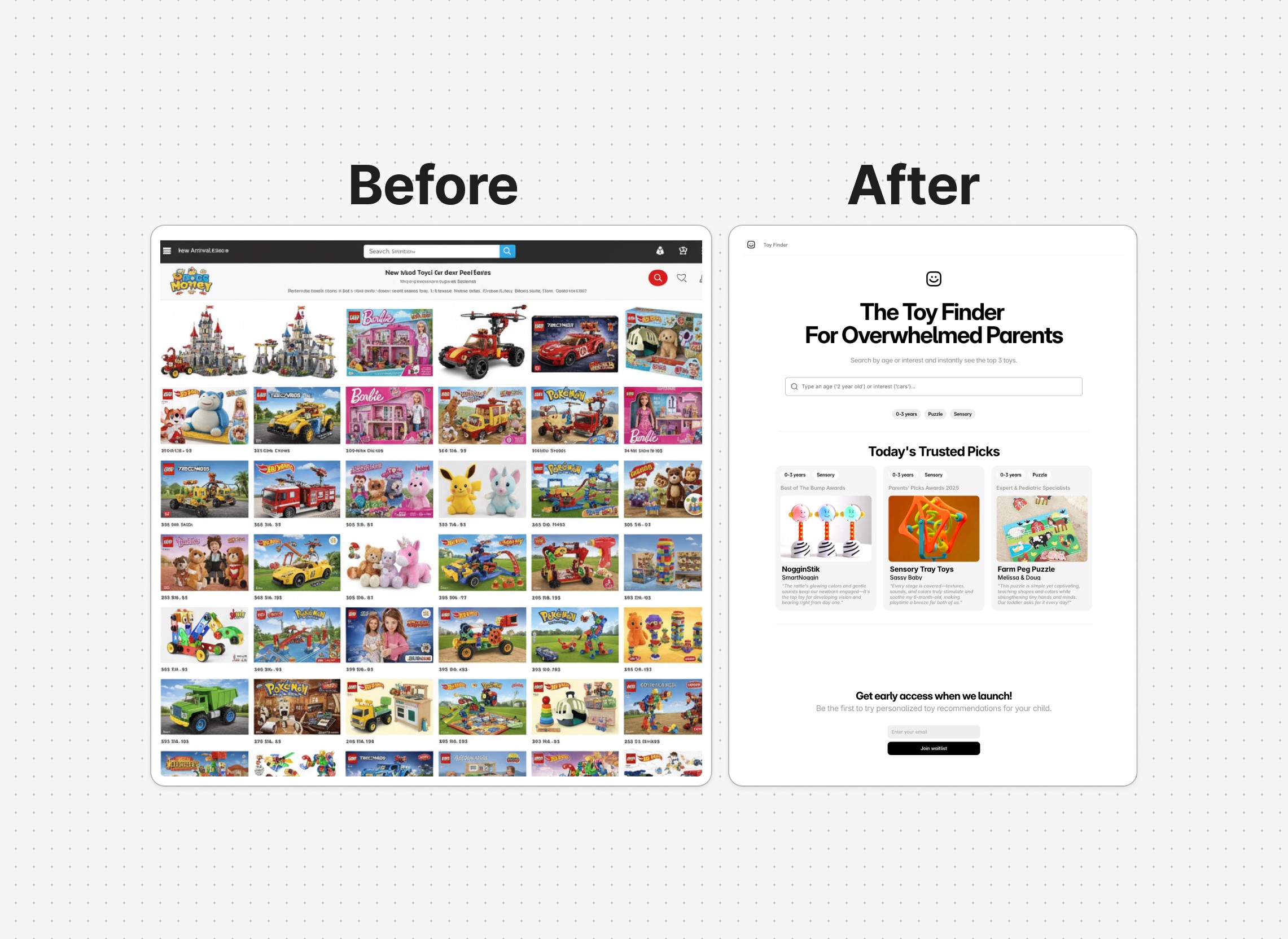
The behind-the-scenes story of Toy Finder, a trust architecture system that taught me more by stopping than shipping.
This is the story behind Toy Finder Trust Architecture → , an IA project I designed for parental decision-making. For the full case study and IA work.
Toy Finder started as an experiment: Could I cut through parental decision fatigue by showing the top 3 expert-backed toy recommendations instead of endless catalogues?
No scrolling. No paralysis. Just three trusted choices.
The Pivot That Got Me Here
This came after scrapping "Playnest," a toy rotation app. User research revealed parents didn't need help organizing toys. They needed help choosing them in the first place.
Selection overwhelm, not clutter, was the real problem.
Listening to that early saved months of building the wrong thing.
What I Built
I designed a 4-tier trust architecture system that organized disparate trust signals (expert reviews, brand recognition, parent testimonials, lifestyle imagery) into a coherent decision framework.
The IA work was solid. I mapped cognitive flow from qualification to consideration to purchase. I structured visual hierarchy to guide attention through information layers. I built a trust taxonomy that made sense at a glance.
The system worked. Parents could filter by who they trusted most: expert recommendations, parent-tested favorites, or award winners. The interface delivered on its promise: reduce overwhelming choice to confident decisions.
What Worked
The three-tier trust framework resonated immediately in early feedback. It gave parents a clear mental model: "Why should I trust this recommendation?"
On the process side, using AI tools (Perplexity for research synthesis, ChatGPT for interview scripts, Framer AI for wireframe generation) accelerated the design cycle by about 60 percent. I went from concept to working prototype faster than I ever had before.
The Problem I Couldn't Solve
The curation model had a scalability problem I couldn't ignore.
Maintaining expert-vetted recommendations across age ranges, developmental stages, and play types required an editorial infrastructure I didn't have. The "top 3" concept worked as a promise, but delivering trusted, regularly-updated content would need a dedicated team and ongoing resources.
I didn't have that. So the model didn't scale.
The Real Insight
Simplifying choice is valuable, but it's not the same as building confidence.
Parents don't just want fewer options. They want to understand why a choice matters for their specific child at this specific moment. The problem is developmental context, not transactional filtering.
I'd built sound information architecture around trust signals, but what parents actually needed was developmental context. The structure was right. The content model wasn't.
Why I Stopped
Instead of forcing Toy Finder to stretch beyond its natural scope, I paused and sat with the insight.
The questions that emerged (How do parents think about developmental stages? What does "right toy, right time" actually mean?) felt more important than solving the curation problem.
So I let it go.
The Takeaway
Killing ideas is progress.
Toy Finder didn't fail. It taught me what the real problem was. And recognizing that early, before overcommitting to the wrong solution, is exactly the kind of learning that moves you forward.
The lesson applies to IA too: sometimes the structure you design isn't the structure users need. And knowing when to scrap it and start over is what separates good architects from stubborn ones.
The behind-the-scenes story of Toy Finder, a trust architecture system that taught me more by stopping than shipping.
This is the story behind Toy Finder Trust Architecture → , an IA project I designed for parental decision-making. For the full case study and IA work.
Toy Finder started as an experiment: Could I cut through parental decision fatigue by showing the top 3 expert-backed toy recommendations instead of endless catalogues?
No scrolling. No paralysis. Just three trusted choices.
The Pivot That Got Me Here
This came after scrapping "Playnest," a toy rotation app. User research revealed parents didn't need help organizing toys. They needed help choosing them in the first place.
Selection overwhelm, not clutter, was the real problem.
Listening to that early saved months of building the wrong thing.
What I Built
I designed a 4-tier trust architecture system that organized disparate trust signals (expert reviews, brand recognition, parent testimonials, lifestyle imagery) into a coherent decision framework.
The IA work was solid. I mapped cognitive flow from qualification to consideration to purchase. I structured visual hierarchy to guide attention through information layers. I built a trust taxonomy that made sense at a glance.
The system worked. Parents could filter by who they trusted most: expert recommendations, parent-tested favorites, or award winners. The interface delivered on its promise: reduce overwhelming choice to confident decisions.
What Worked
The three-tier trust framework resonated immediately in early feedback. It gave parents a clear mental model: "Why should I trust this recommendation?"
On the process side, using AI tools (Perplexity for research synthesis, ChatGPT for interview scripts, Framer AI for wireframe generation) accelerated the design cycle by about 60 percent. I went from concept to working prototype faster than I ever had before.
The Problem I Couldn't Solve
The curation model had a scalability problem I couldn't ignore.
Maintaining expert-vetted recommendations across age ranges, developmental stages, and play types required an editorial infrastructure I didn't have. The "top 3" concept worked as a promise, but delivering trusted, regularly-updated content would need a dedicated team and ongoing resources.
I didn't have that. So the model didn't scale.
The Real Insight
Simplifying choice is valuable, but it's not the same as building confidence.
Parents don't just want fewer options. They want to understand why a choice matters for their specific child at this specific moment. The problem is developmental context, not transactional filtering.
I'd built sound information architecture around trust signals, but what parents actually needed was developmental context. The structure was right. The content model wasn't.
Why I Stopped
Instead of forcing Toy Finder to stretch beyond its natural scope, I paused and sat with the insight.
The questions that emerged (How do parents think about developmental stages? What does "right toy, right time" actually mean?) felt more important than solving the curation problem.
So I let it go.
The Takeaway
Killing ideas is progress.
Toy Finder didn't fail. It taught me what the real problem was. And recognizing that early, before overcommitting to the wrong solution, is exactly the kind of learning that moves you forward.
The lesson applies to IA too: sometimes the structure you design isn't the structure users need. And knowing when to scrap it and start over is what separates good architects from stubborn ones.