Intent Architecture
Industry
Events
Service
Navigation & IA Redesign
Challenge
Complex navigation
Outcome
Intent-based structure
(01)
Project overview.
SMASH! is a community-driven anime and pop culture convention with a complex digital ecosystem. Their navigation listed 9 top-level items without a clear organising principle, forcing users to decode organisational logic before finding what they needed.
I restructured the navigation around 3 user intentions- Find, Explore, and Do - creating a framework that matches how people actually approach convention planning rather than how the organisation structures itself internally.
(02)
Challenge.
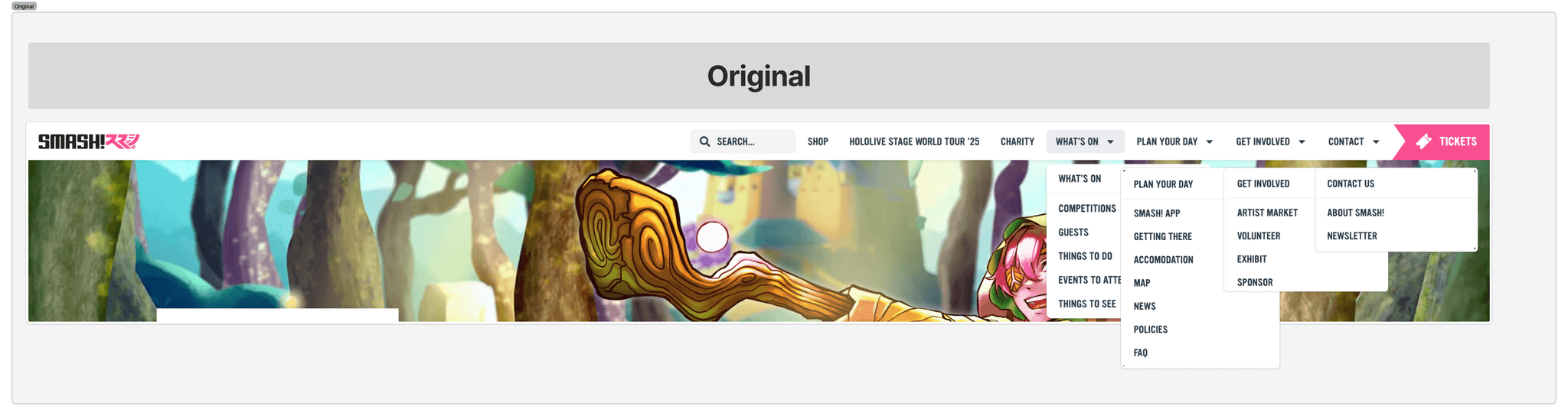
The navigation presented 9 disparate items: Search, Shop, special events, What's On, Plan Your Day, Get Involved, Contact, and Tickets. While individually functional, the structure lacked a unifying logic. Users couldn't quickly identify which path matched their current intent.
The real problem wasn't discoverability, it was cognitive load. Each visit required users to mentally categorise options themselves: "Am I browsing or buying? Is this planning or participation?" The navigation abdicated this organisational work to users.
Within "Plan Your Day," a flat list treated the SMASH! app as another link rather than a container. Schedule was missing entirely. Critical planning tools sat alongside secondary support content with no hierarchy indicating priority or relationship.
(03)
Approach.
I audited the navigation by mapping each item to user intent: "What is someone trying to accomplish at this moment?" rather than "What type of content is this?"
My audit process involved:
Clicking through every menu item to verify content matched its label
Identifying mislabeled or unclear navigation items and proposing more accurate terminology
Finding redundancies like "Get Involved" appearing both as a parent category and a child item, then resolving them (in this case, renaming the child to "Overview" since it served as an entry point to sub-options)
Grouping fragmented related content—"things to do," "events to attend," and "things to see" were split across separate items when they represented one user goal, so I consolidated them into "Activities & Events"
This content-first audit revealed duplication, unclear relationships, and missed grouping opportunities before I mapped items to intent.
Three distinct behavioural modes emerged:
Directed search - Users who know exactly what they need
Discovery and planning - Users exploring options and preparing logistics
Transaction - Users ready to complete an action
I organised content into these intent-based groups and validated the framework with the team by asking: "Can someone immediately identify which category matches their goal without understanding how SMASH! structures itself internally?"
Within each category, I built hierarchy to surface relationships, particularly critical for "Plan Your Day" where the flat structure obscured what belonged where and what the app actually provided.
(04)
Solution.
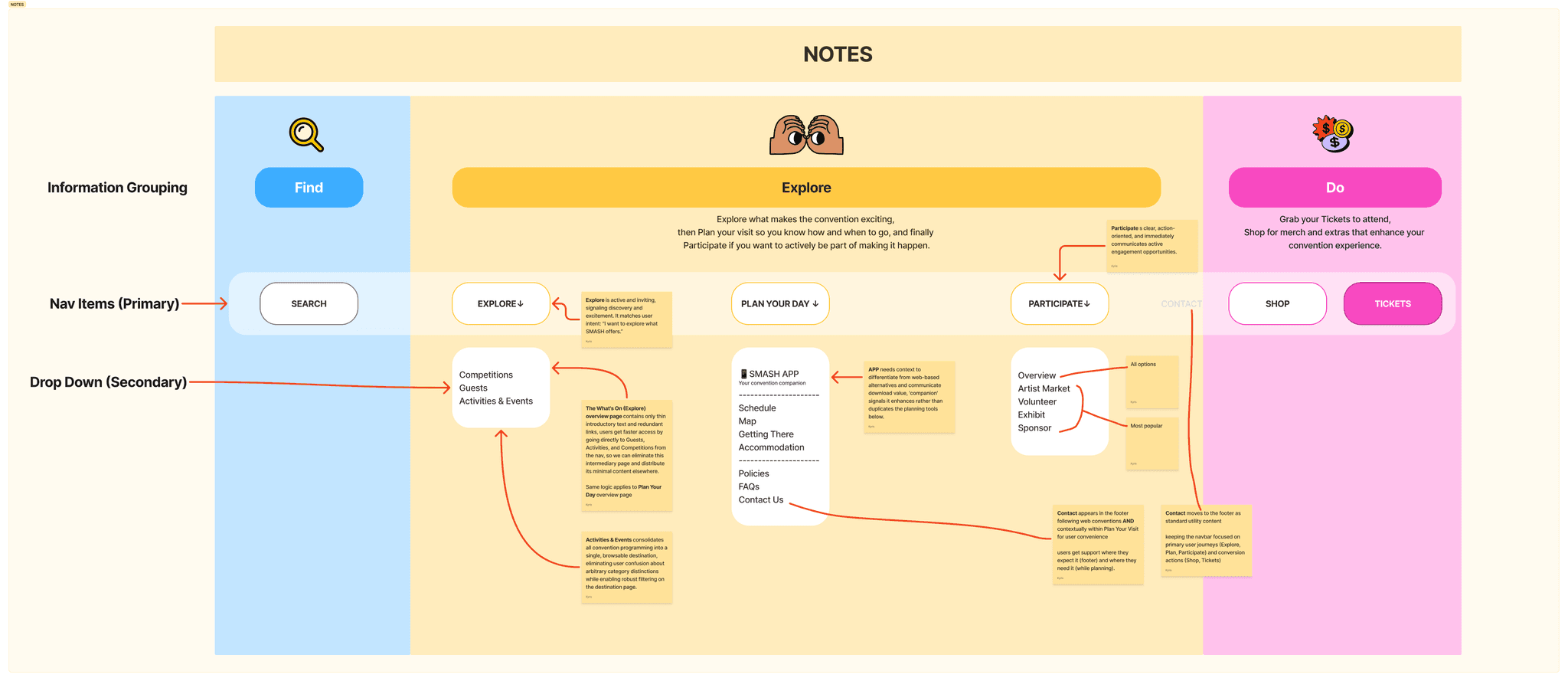
I restructured the navigation into three intent-based categories:
FIND - Elevated search to a primary category with equal visual weight, giving direct access to users who know what they need.
EXPLORE - Consolidated all discovery and planning content:
Explore (Competitions, Guests, Activities & Events)
Plan Your Day (SMASH! app (About the app page); Schedule, Map, Getting There, Accommodation; then Policies, FAQs, Contact Us as secondary support)
Participate (Overview, Artist Market, Volunteer, Exhibit, Sponsor)
DO - Isolated Shop and Tickets as transactional endpoints.
(05)
Decisions.
Intent over content type
Organising by user goal (find, explore, act) rather than content category reduces the cognitive work of translating organizational structure into personal need. This meant sacrificing individual top-level visibility for three items in exchange for immediate clarity about which path to take.
Search as primary action
Making Find a top-level category with equal prominence respects users who arrive with specific goals and shouldn't navigate layered menus to access search.
Consolidating discovery under one parent
What's On, Plan Your Day, and Get Involved all serve the same intent, understanding the convention. Grouping them signals "this is where you browse and learn" rather than forcing users to guess which dropdown contains what they need.
Separating transactions
Isolating Shop and Tickets under Do creates clear distinction between exploration and action modes. Users don't wade through discovery content when ready to purchase.
Showing relationships through hierarchy
Nesting app features (Schedule, Map, Getting There, Accommodation) under SMASH! APP communicates what the app contains and why someone would download it. Adding Schedule, previously missing and separating support content (Policies, FAQs, Contact) from planning tools creates scannable priority.
(06)
Result.
The navigation transformed from a 9-item list requiring mental categorization into a three-category system where intent is immediately clear.
Users identify their path based on current need rather than parsing organisational logic. Proper hierarchy shows relationships throughout, what the app contains, what's essential versus supplementary, how pieces connect. Critical gaps like Schedule are now visible and correctly positioned.
The 3-category structure is inherently scalable. New content, additional events, activities, participation opportunities, fits within existing buckets without requiring structural changes. The framework absorbs growth while maintaining clarity.
The architecture does the organizational work so users don't have to.